
Sammi Cannold & Paolo Montalban Find the Life in Grim at La Jolla Playhouse
By Cesar A. Reyes
What if the Grim Reaper had a retirement plan?
Not exactly the question you expect when you hear the words Grim Reaper. You might picture a dark cloak, a giant scythe, and somebody having a very, very bad day. But Grim, the brand-new musical making its world premiere at La Jolla Playhouse, has something else in mind. What if the Grim Reaper was tired? What if he had spent 300,000 years doing the same job and suddenly had to figure out who he was without it? What if, underneath all that darkness, there was a surprisingly relatable guy wondering what comes next? That is where Grim gets interesting.

“It’s a show about life,” says director Sammi Cannold, even though death is right there in the title. For Cannold, that contradiction is part of what makes Grim so compelling. She was hooked almost immediately. Her first introduction to the new musical was a one-sentence description of the story, followed by the opening number, “We Are the Deaths.” That was all it took to pull her into this strange, unexpected universe. “I was hooked immediately,” she says. “The sound of the score was like nothing I had ever heard in musical theater before, the conceit was so original, and I fell for Diana, Grim’s daughter, who is at the center of the story as she wrestles with whether she truly wants to step into her father’s role as the Grim Reaper. I fell in love with her love of life, and that felt like such a beautiful contradiction for a character who is being asked to take on death.”
For Cannold, theater has been part of her DNA for as long as she can remember. Her mother worked in musical theater, so as a child she spent time backstage, sitting through rehearsals and tech and watching the controlled chaos that turns a script into a living thing. As a teenager, she got her first opportunity to direct, taking on Joseph at a summer program. “From there, I was hooked,” she recalls. That early fascination eventually became a career built around bringing people together to tell stories, and Grim gives her an especially unusual story to tell because there is no established production waiting for her to follow.

Unlike a revival or a familiar musical, Grim comes without a roadmap. There is no previous production to imitate, no definitive Grim Reaper waiting in the wings to tell Paolo Montalban how to play him, and no established visual world for Cannold and her design team to recreate. Everything has to be invented. “All of the musicals I’ve directed previously have been grounded in some kind of historical or present reality,” Cannold says. “But this one takes place in a universe that may or may not exist—and if it does exist, none of us have ever seen it.” That blank canvas has become one of the show’s greatest creative opportunities. Cannold and the design team have looked everywhere for inspiration, exploring centuries of images and interpretations of death, from Hieronymus Bosch’s The Garden of Earthly Delights to Pixar’s Coco, searching for a visual language that can make this strange universe feel completely real.
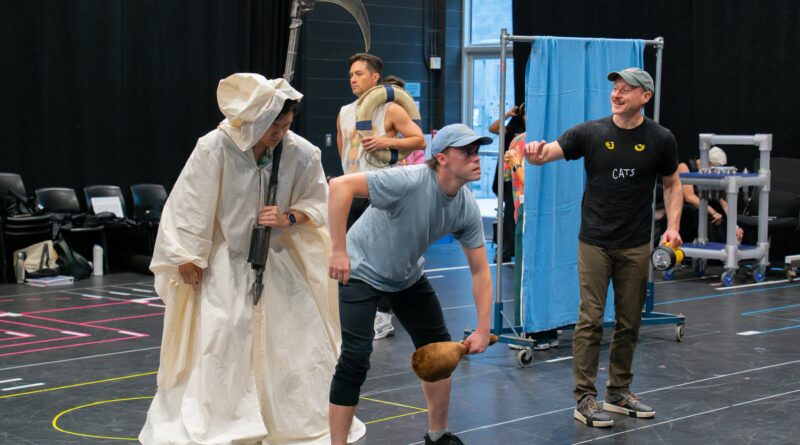
Creating that world requires more than simply showing up for rehearsal. Cannold and choreographer Andy Blankenbuehler, known for his work on Hamilton, have spent years developing the musical, with much of the work happening away from the rehearsal room. They sketch ideas into scripts, talk through possibilities on the phone and keep shaping the production before the performers ever step onto the stage. Then the actors arrive and bring something none of the creative team can manufacture on their own. “They bring a whole new set of ideas and energy to the show,” Cannold says. “That adds a whole other layer to the work and dimension to the collaboration, which is invaluable.” For Cannold, that combination of preparation and unpredictability is part of what makes directing a musical so addictive. She describes the work as “organized chaos,” the constant challenge of taking something enormous and unwieldy and finding a way to make all of its moving parts work together.
For Paolo Montalban, that collaboration has meant creating a character who technically has been around longer than human civilization, yet somehow has problems that feel incredibly familiar. Montalban has spent decades moving between stage and screen, from his memorable turn as Prince Charming in the 1990s version of Cinderella to a wide range of characters throughout his career. But becoming the Grim Reaper is a different kind of acting challenge because there is no previous performance to study and no definitive version to copy. He is helping create the character for the first time. Montalban was particularly drawn to the depth behind Grim. By the time he began working with the creative team, the writers had already developed an extensive mythology around their 300,000-year-old Grim Reaper, giving him a history that goes far beyond the familiar image of a cloaked figure carrying a scythe.

But Montalban wanted to find the person underneath the legend. He remembers talking with Cannold about audiences who might see something of themselves in Grim’s retirement dilemma, particularly people who have reached a point in their own lives when the job or role that once defined them begins to change. “I shared my hope that certain audience members who were nearing retirement or had already achieved it, see themselves in Grim’s personal experience,” Montalban says. That conversation helped him find a way into the character that was much more human than supernatural. “What if I approached Grim like he was one of us?” he says. Suddenly, the Grim Reaper has insecurities, conflicted feelings, and an identity crisis. His job isn’t simply what he does; it is who he has been for 300,000 years. If that job is coming to an end, then the bigger question becomes: Who is Grim when he is no longer the Grim Reaper?
The emotional history underneath the character becomes even more complicated through the show’s music. A lyric from “The Death of Love” stayed with Montalban: “Do you know what humans go through – what we take from them?” The line helped him understand the emotional damage behind Grim’s darkness and gave him a way to explore what might have hardened this character over the centuries. “Living life is a naturally heroic feat,” Montalban says. “In order to match that level of heroism, the Grim Reaper literally has to be the grimmest being in the universe.” It is a surprisingly tender way of looking at death. Grim may represent the end, but his understanding of humanity comes from watching people struggle, love, lose, survive and keep going.
That idea is at the center of what makes Grim different from what audiences might expect. Cannold and the creative team were determined to not make a musical about death that leaves audiences feeling like they need a therapist and a long nap afterward. “It was really important to the rest of the creative team and I that even though death is at the center of Grim, we make a show that is joyous, hilarious, and heart-filled,” Cannold says. “It’s that juxtaposition—that good and bad—that is the spine of Grim.” Montalban sees that same lightness emerging from the production. “Audiences will be surprised by how much light a show about death can have,” he says, promising irreverent jokes, plenty of music and songs that are, in his words, “actual bops.” Beneath the humor is something more universal: the realization that perhaps we have far more in common with one another than we think we do.
There is also something thrilling about being part of a story that nobody has seen before. The actors don’t know exactly where the first big laugh will land, the creative team doesn’t know which moment will leave the theater silent, and there is no history telling everyone what to expect. Montalban is looking forward to experiencing that uncertainty with the audience. “I’m really looking forward to hearing the first gasp, the first laugh, and the first span of stillness when you know the audience is really listening,” he says. For him, the experience recalls something almost ancient: the first storytellers gathering around a campfire, telling a story for the first time and discovering it together with the people listening.
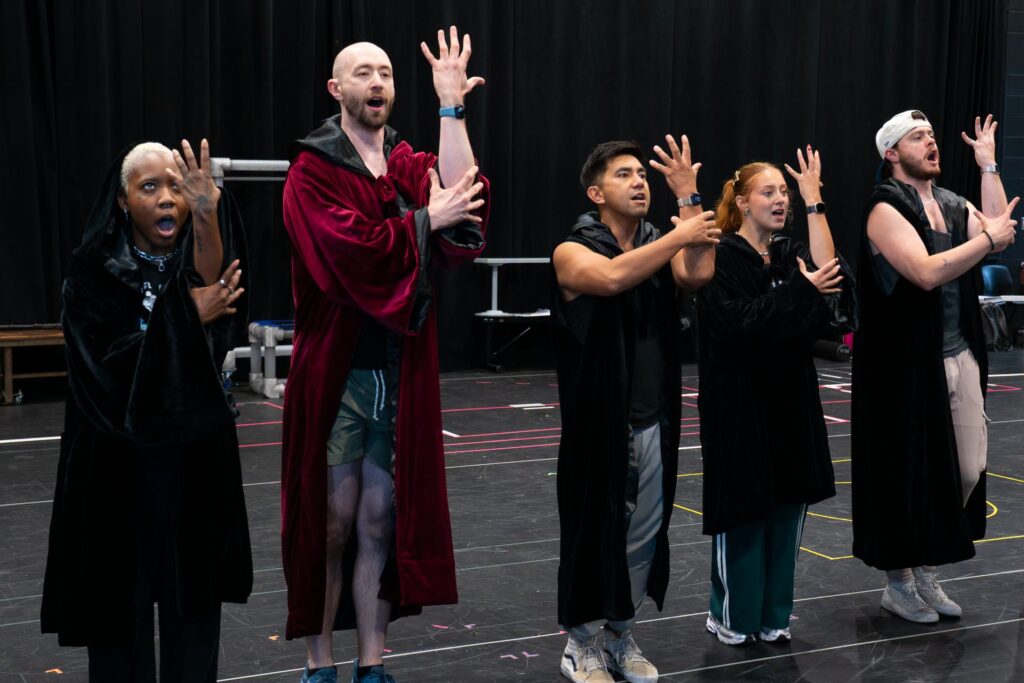
That sense of discovery makes La Jolla Playhouse an especially fitting home for Grim. The theater has a long history of developing new musicals before they find their wider audiences, and Cannold describes the experience of developing this one in San Diego as “dreamy.” The musical began taking shape during the pandemic, with the writers putting pen to paper before Cannold joined the project and the creative team continued developing the show over the years that followed. The five-week rehearsal and tech process in La Jolla represents only the visible part of a much longer journey.
For Montalban, the magic of creating Grim is in watching all those individual talents come together. He compares the creative process to watching master painters work on a single canvas, each bringing a different technique while contributing to the same picture. He remembers watching choreographer Andy Blankenbuehler build a large ensemble number, using each performer almost like a different color on a palette, bringing people together, separating them and blending them into the larger image. “It felt like jazz improvisation through movement,” he says. That spirit of collaboration runs through the entire production, with writers, actors, designers, musicians, choreographers and directors all contributing to something that has never existed before.
Cannold hopes audiences leave the theater thinking differently about life and death, although she is intentionally keeping some of the details close to the vest. Montalban’s hope is more immediate: that audiences laugh, cry, hum the songs and step outside into the San Diego air feeling that something has shifted. “I hope our audiences spend two and a half hours with us laughing and crying, are humming the show’s songs as they leave the theatre, and walk out into the fresh San Diego air with a new lease on life.”
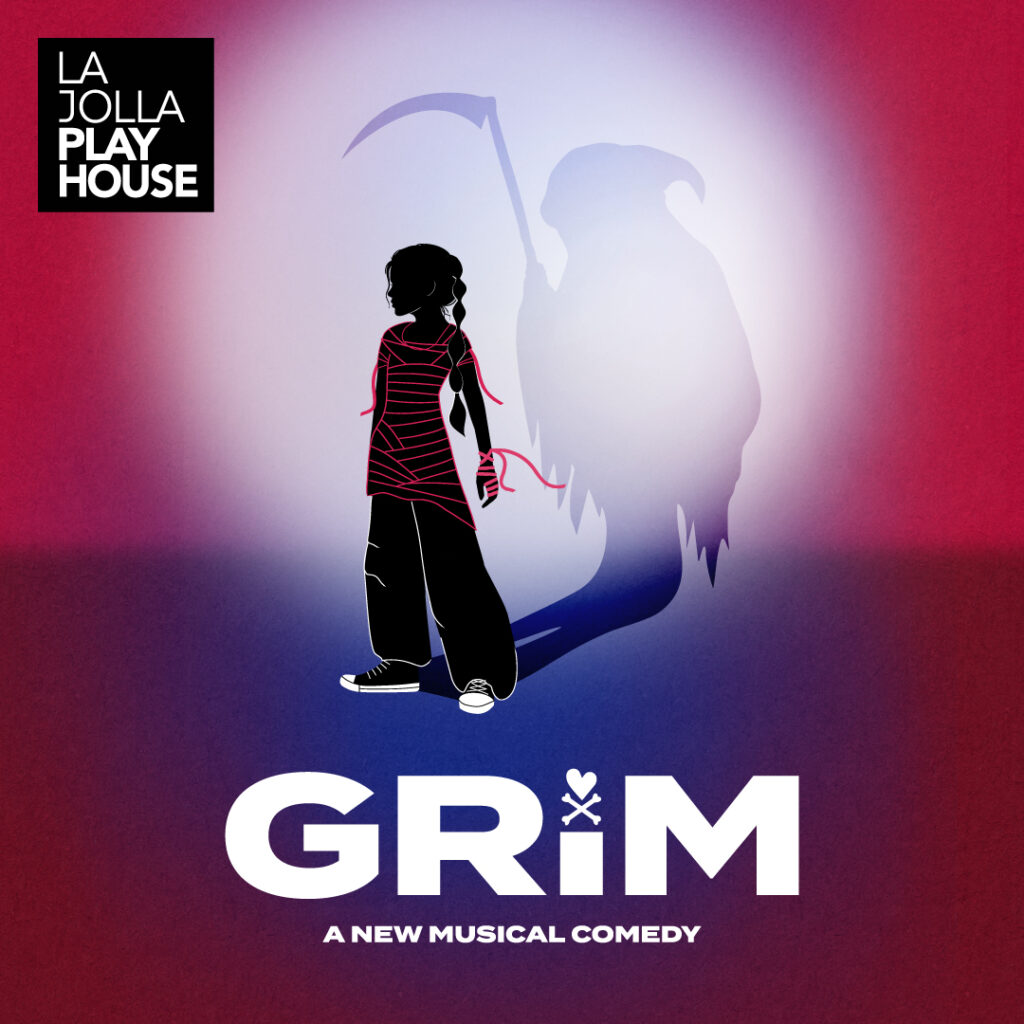
Maybe that is the real trick of Grim. Take the character most associated with the end of everything and give him a question about what comes next. Strip away the cloak and the mythology, and suddenly the Grim Reaper is wrestling with the same questions that eventually find all of us: Who am I? What happens when the thing that defined me changes? And how do I make the most of the time I have?
For a musical about death, Grim seems determined to remind us that the most interesting part of the story is everything that happens before the curtain falls.