

Queer Calendar App: Tamara Wendt’s Blueprint for Queer Connection
By Cesar A Reyes
Tamara Wendt didn’t start with a grand plan to launch a platform—she was just trying to find her people. When she landed in San Diego, life felt smaller than she expected. “I was single… dealing with some health challenges, and spending a lot of time alone,” she says. Like so many of us, she went looking for connection, for something that felt like community. What she ran into instead was a scattered, frustrating mess. Events were buried across social media platforms, posted too late, or hidden in stories that disappeared before anyone could act on them. “It was frustratingly hard. I kept seeing things I missed that I would have loved to attend,” she says. That feeling—missing out on your own community—stuck with her. “I kept thinking… I wish this was just a simple search.” The more she asked around, the clearer it became: everyone else was struggling with the same thing.
What grew out of that frustration is now Queer Calendar, a queer-owned, queer-driven map of community that’s trying to do something both simple and vital—make it easy for us to find each other. Not just during Pride, not just in bars or big events, but across the full spectrum of queer life. “For me, finding ways to meet up with other queer people in person and online is a lifeline to community,” Tamara says. “I don’t have much other family.” That truth sits at the center of the project. Queer Calendar isn’t just about convenience, but about survival in the everyday sense, about creating access to spaces where people can show up fully as themselves. “There is just something about being in our spaces that feels so different than straight ones,” she says, naming something many people feel but rarely articulate.

As she started building the platform, Tamara realized how much was already out there—just hidden. “I discovered so many volunteer opportunities, book clubs, car meetups, and gayming and Gay Rodeo, and Queer Climbing, and soooo much more,” she says. What she once thought was a limited landscape—Pride parades and nightlife—opened into something expansive and creative. “The creativity of what is out there is so beautiful.” Queer Calendar became a way to surface that beauty, to map it in real time. Today, the platform includes thousands of event organizers—over 3,000 and growing—with a goal of reaching 10,000 by the end of 2026. It’s global, spanning in-person and online spaces, reflecting the reality that queer community doesn’t live in one place or follow one pattern.
But what makes Queer Calendar different isn’t just the volume of events—it’s who it’s built by and who it’s built for. In a digital world where so much of queer life is filtered through platforms that don’t always support or protect it, ownership matters. “Our community needs spaces where we can show up as ourselves without worrying about who’s watching, tracking, or selling our data,” Tamara says. A queer-owned platform shifts that dynamic. It means decisions about data, visibility, and access stay within the community. It also creates resilience against the unpredictability of mainstream platforms. “Channels built for and by our community make us resilient to Instagram, Facebook, and Google censorship and bad policies,” she explains. Instead of building queer community on borrowed ground, Queer Calendar is about creating infrastructure that actually belongs to us.
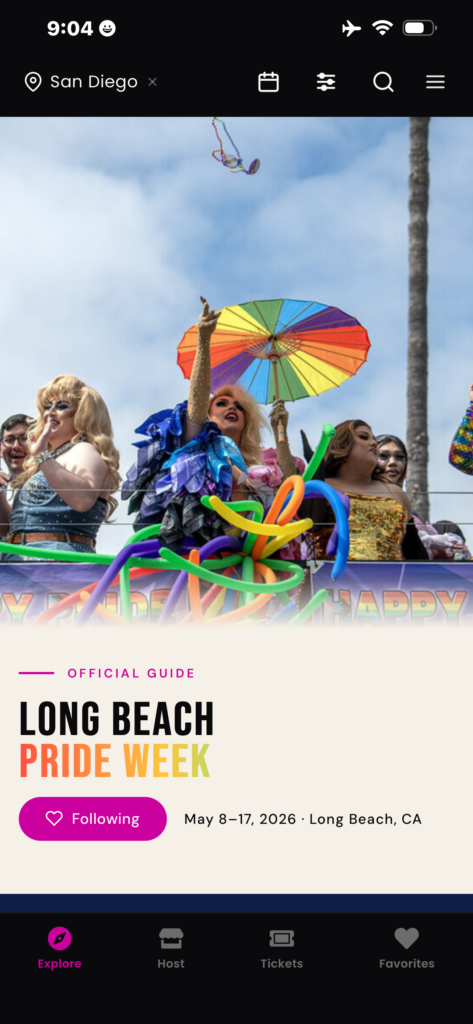
That ownership also extends to economics. LGBTQ+ communities generate trillions in spending power globally, yet much of that money flows into systems that don’t reinvest in queer lives. Queer Calendar interrupts that cycle. For event organizers and businesses, it acts as both a discovery tool and a built-in support system. “Think of us as an extension of your marketing team—promo for the homos,” Tamara says. Events are free to list, with a simple “bring your own link” approach that doesn’t force organizers to abandon their current systems. But for those who choose to use Queer Calendar’s ticketing, there’s an added layer: the fees that usually disappear into corporate platforms are redirected back into the community. “Those dollars turn into a fundraiser for our community, without spending a dime,” she says.
The timing of the platform’s expansion feels intentional. As Queer Calendar rolls out its mobile app, launching alongside Long Beach Pride on May 4, it’s positioning itself as more than a seasonal tool. The app will allow users to navigate Pride events, find details like accessibility and maps, and build out their own schedules—but the goal is what happens after. Once Pride ends, the map stays active. The community doesn’t disappear. Partnerships are already expanding to cities like Houston and Guadalajara, with more being added steadily, building a network that connects queer communities across borders. At the same time, the platform is working toward raising $100,000 through no-cost benefit ticketing by the end of 2026, proving that a tool built for discovery can also become a vehicle for sustainability.

At its core, Queer Calendar is still rooted in that original moment—someone searching, feeling alone, and knowing there had to be a better way. Now, it’s becoming that way for others. A living, growing map of where we gather, create, organize, and celebrate—built by us, for us, and driven by the simple idea that finding each other shouldn’t be this hard. As Tamara puts it, “The WORD is Discovery. Let’s find each other. We are so much stronger together.”