

Monica Hernandez: A Two-Spirit Xicana Leading Culture and Community in Barrio Logan
By Cesar A Reyes
Monica Hernandez doesn’t separate who she is from the work she does. Ask her where it starts, and she’ll take you back to the border—born in Tijuana, raised in San Ysidro—moving between places, languages, and ways of seeing the world. “That upbringing deeply shapes who I am and how I move through my work,” she says. Long before holding the title of Executive Director of the Chicano Park Museum and Cultural Center, she was already rooted in community—as a two-spirit Xicana cultural worker, curator, and storyteller building spaces where people could show up as their full selves.
Her connection to Barrio Logan began more than 15 years ago, through grassroots art and community building. As co-founder of Front Arte y Cultura in San Ysidro, Monica worked closely with artists across the South Bay and Barrio Logan, creating space where there wasn’t any—especially for queer BIPOC creatives. “There weren’t many safe spaces for us to create and express ourselves,” she recalls. “Much less for queer BIPOC folks.” Those early collaborations rooted her in a network of artists and organizers who were not waiting for permission to exist—they were building something of their own.
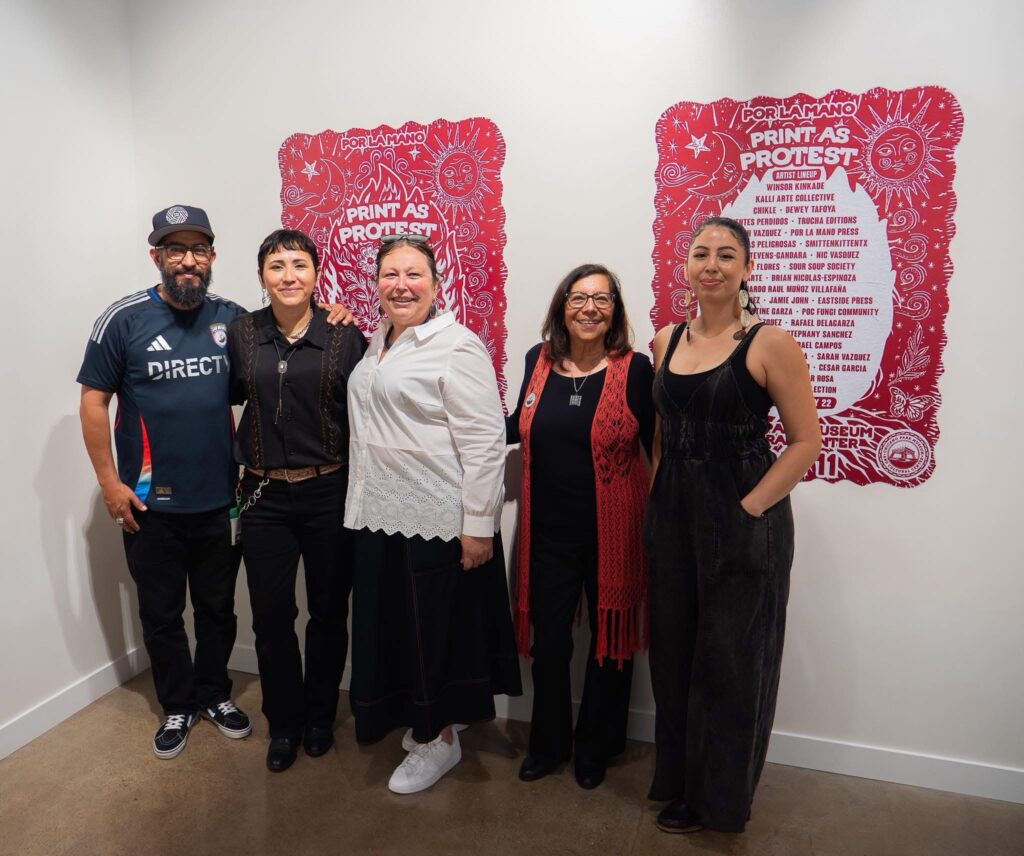
That same spirit now lives in her leadership at the Chicano Park Museum and Cultural Center. The work is layered: exhibitions, workshops, community dialogue, and the careful building of an archive that honors the legacy of Chicano Park and the movement that made it possible. But at its core, Monica sees her role as one of service. “Ultimately, my role is about service—to the community, to our shared history, and to future generations,” she says. It’s a responsibility she holds with intention, making sure the space reflects the “living, evolving spirit of Barrio Logan.”
You can’t talk about Barrio Logan without talking about resistance. From the 1970 Chicano Park takeover to ongoing fights against environmental injustice and displacement, the neighborhood has always been shaped by people who refused to be erased. Monica situates herself within that lineage while also naming the tensions that persist. “More recently… there’s been gentrification, displacement, criminalization,” she says, pointing to ICE raids and systemic neglect. But alongside that, she sees something else: “a resurgence in culture, community organizing… the need to be more close knit.” Out of pressure, something resilient continues to grow.

When the conversation turns to identity, Monica is careful, intentional. While often placed under the umbrella of Queer Xicanx leadership, she names her truth with nuance. “I don’t explicitly identify as queer; it’s an identity I’m still learning,” she explains. “I identify as a Two-Spirit Xicana, grounding my understanding of self in a reconnection to my Indigenous ancestors.” That distinction matters—not as a rejection, but as an expansion. Her leadership isn’t about fitting into a label; it’s about creating space for complexity. “Leadership can be fluid, relational, and guided by balance rather than hierarchy,” she says.
That approach shapes how she understands visibility. It’s not about being the face of something—it’s about showing up honestly. “Visibility, for me, is not about being labeled—it’s about being present, intentional, and accountable,” she says. She knows that people are watching, sometimes seeing possibility in her before she fully sees it herself. “That can feel heavy,” she admits, “but it’s also an invitation to lead with integrity, openness, and vulnerability.” In that way, her presence becomes permission—for others to question, to grow, to exist outside rigid definitions.
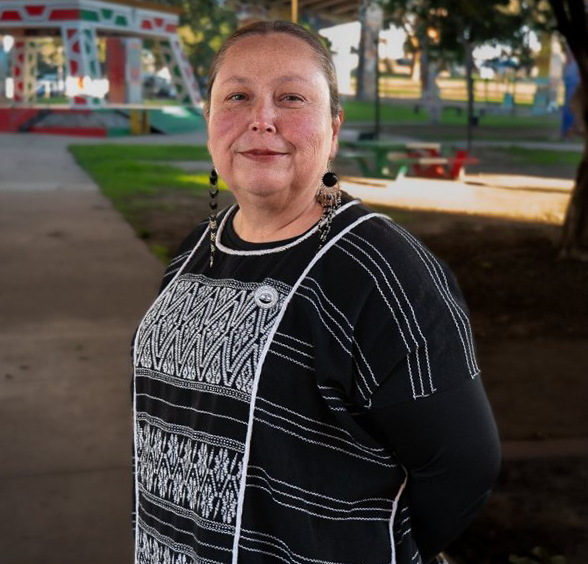
In Barrio Logan, that permission is starting to take root in new ways. LGBTQ+ folks, especially those within the broader Queer Xicanx community, can find both history and possibility here. From the murals of Chicano Park to the evolving programming at the museum, the neighborhood offers more than representation—it offers participation. “It’s not just a place to visit—it’s a place to contribute,” Monica says. Still, there’s something missing. “Our LGBTQ+ and queer histories are still underrepresented,” she adds, naming the work that still needs to be done.
For Monica, the word that ties it all together is simple: The WORD is Movimiento. “It speaks to the social justice work rooted in Barrio Logan, but also to something deeper—the ongoing evolution of self and community,” she says. Movimiento isn’t always loud or fast. Sometimes t’s slow, like a snail. Sometimes it’s internal. But it’s constant. “What matters is the commitment to keep going,” she says, “to not lose sight of our vision.”
And in Barrio Logan, that vision is still being written layer by layer, story by story, movement by movement.