

Sherri Eden Barber and Harrison David Rivers Ask What Comes After Comfort in Straddle
By Cesar A Reyes
Listening to Sherri Eden Barber and Harrison David Rivers talk about theatre feels like overhearing a conversation about love—one that’s endured, evolved, and refuses easy answers. That shared sensibility is the heartbeat of Straddle, the world-premiere play they created together, where love doesn’t arrive neatly resolved and intimacy refuses to stay static. The play opens on a married lesbian couple celebrating their fourteenth wedding anniversary. They are deeply in love, still attracted to one another, and quietly unsure how to bridge the widening gap between comfort and desire. From the start, Straddle makes it clear it isn’t interested in tidy arcs or easy answers. Instead, it settles into the ache most long-term couples recognize immediately: the moment when routine begins to dull curiosity, when passion doesn’t disappear but starts asking different questions.
For Barber, who serves as Artistic Director of Diversionary Theatre in San Diego, the story grew from a deeply personal need. Originally from Baltimore, she built her career directing across New York City, London, Edinburgh, regional theatres, and on the road as Resident Director for Hamilton’s (And Peggy Company) Tour. She knows what it means to tell the same story again and again while keeping it alive. Now, at Diversionary, she’s asking a different question: whose stories are still missing, and why? “I wanted to see a story about two women over forty who are portrayed as fully alive both emotionally and sexually,” Barber says. “Not sidelined. Not sanitized. Not treated as invisible.” When she couldn’t find that play, she decided to help make it.
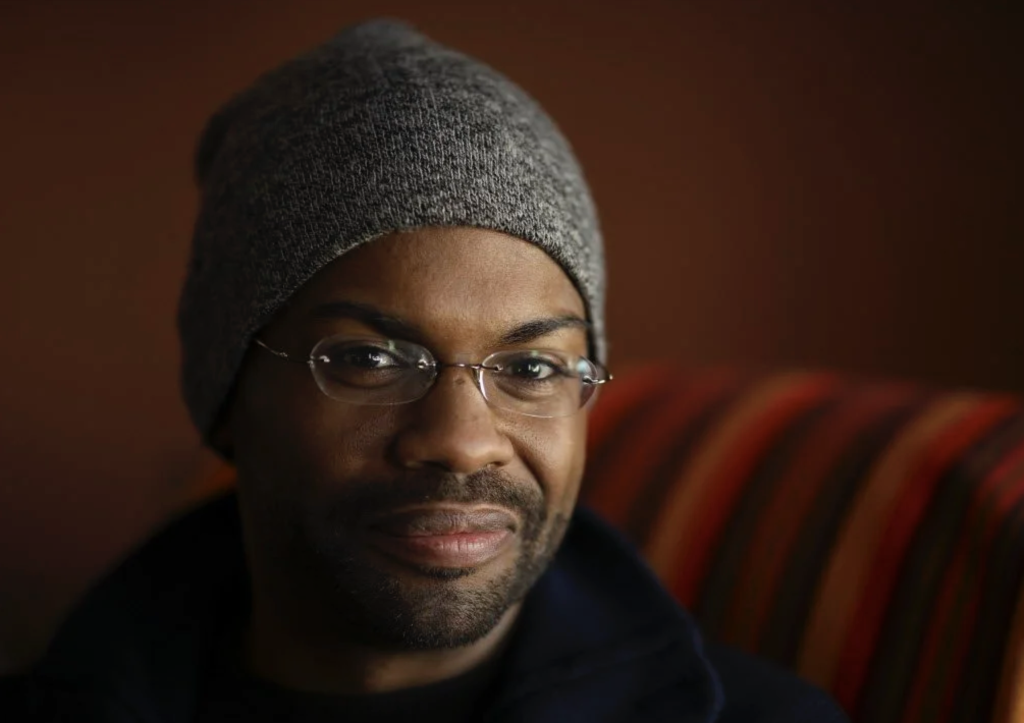
That decision led her back to Rivers, a playwright, librettist, and television writer based in St. Paul, Minnesota, whose work often lives where intimacy and reckoning collide. Though he doesn’t live in San Diego, Rivers considers Diversionary an artistic home. Straddle marks his fourth collaboration with the theatre, following When Last We Flew, This Bitter Earth, and now a world premiere timed to the company’s 40th anniversary season. When Barber asked him to write what she described as “a sexy lesbian play featuring women over forty” Rivers didn’t hesitate. “That was the assignment,” he says, smiling. “And it felt necessary.”
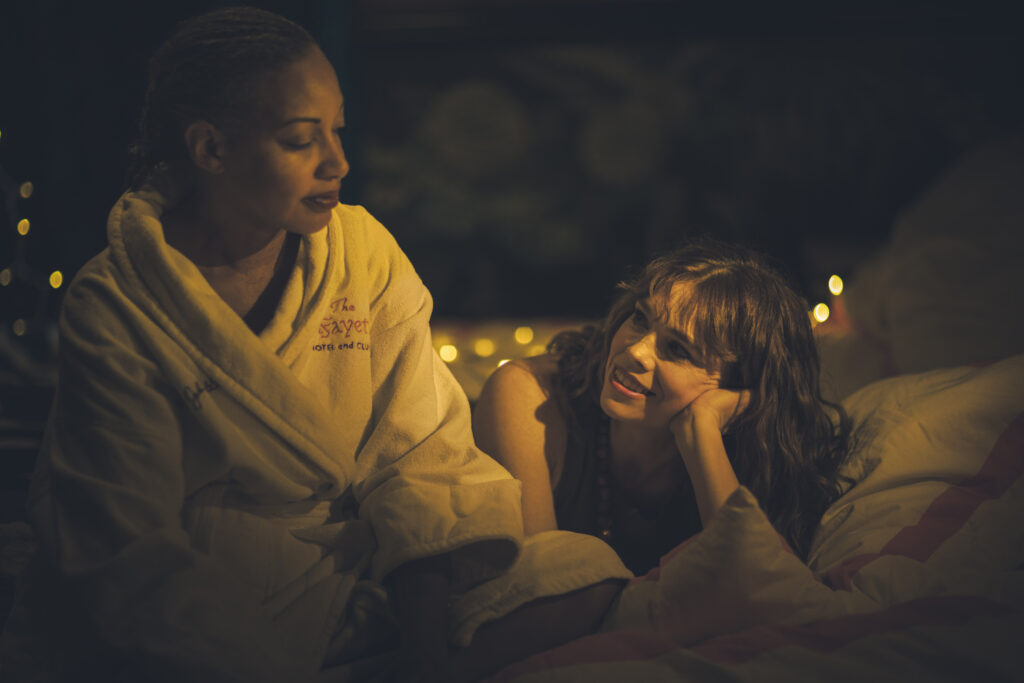
At the center of Straddle are Dodie and Vita, fourteen years into their marriage and standing at a crossroads. The play lives in the details: from ice buckets to obscure 1980s movie references. “It’s about inside jokes and hotel room dance parties,” Rivers says. “Secrets and lies and trust and undeniable connection.” These aren’t symbols; they’re the small, shared rituals that make a relationship feel real. The kind of shorthand only two people who have lived a long time together understand—and the kind that can begin to feel fragile when you’re no longer sure you’re growing in the same direction.
What Straddle refuses to do is frame that moment as failure. Barber is clear about that. “They’re complex, funny, messy, desirable lesbians whose inner lives and erotic lives still matter,” she says. “I wanted their age to be part of their richness, not something to apologize for. Their queerness not as a theme, but as a given.” Rather than romanticizing or catastrophizing the shift in desire that can happen in long-term relationships, the play lingers inside it. It pays attention to the pauses, the jokes that land sideways, the tenderness that flickers even when things feel stuck. At its core is a question many couples recognize immediately: are we still meeting each other, or are we just managing each other?
Barber and Rivers’ collaboration is rooted in deep trust, built over more than twenty years of knowing one another. They first met in New York City, where Rivers was struck by Barber’s artistic vision. “He writes in images,” Barber says. “He gives me space to paint from his words.” That shared language allowed them to take risks, creating characters who live fully in their bodies, their contradictions, and their wanting. Their partnership is also personal: Rivers was the one who encouraged Barber to apply for the Artistic Director role at Diversionary. “He called me and said, ‘You’re meant to do this,’” she recalls. Straddle premiering at Diversionary now feels like a full-circle moment—not just a new play, but a statement of what Barber wants the theatre to be. “A place where bold new work is born,” she says. “Not just a venue, but a home.”
That philosophy carries into Barber’s rehearsal room, where curiosity is protected as fiercely as craft. “Long-term relationships and long-term creative practices face the same danger: autopilot,” she says. “Competence replaces curiosity.” Her antidote is disruption—inviting uncertainty, play, and risk back into the process. “Heat comes from presence,” Barber says. “From paying close attention. From allowing yourself to be changed by what you’re touching—whether that’s another human being or a moment unfolding onstage.” Rivers sees the parallel clearly. “In writing, as in relationships, it’s imperative to try new things,” he says. “If we don’t change, we don’t grow. If we don’t grow, we aren’t really living.”
Straddle is also a communal act, shaped by a wider creative family including dramaturg Christopher Oscar Peña, set and lighting designers McKenna Perry and Annelise Salazar, and actors Summer Broyhill and Marti Gobel. “It truly does take a community to make a play,” Rivers says, and that sense of being held is palpable in the work. Asked to sum up Straddle in a single word, Barber offers faultline. “It’s where love, sex, and time crack open,” she says, “and everything we’ve avoided comes rushing in.” Rivers chooses two words instead: “Intimate,” he says, then after a pause, “Voyeuristic.”
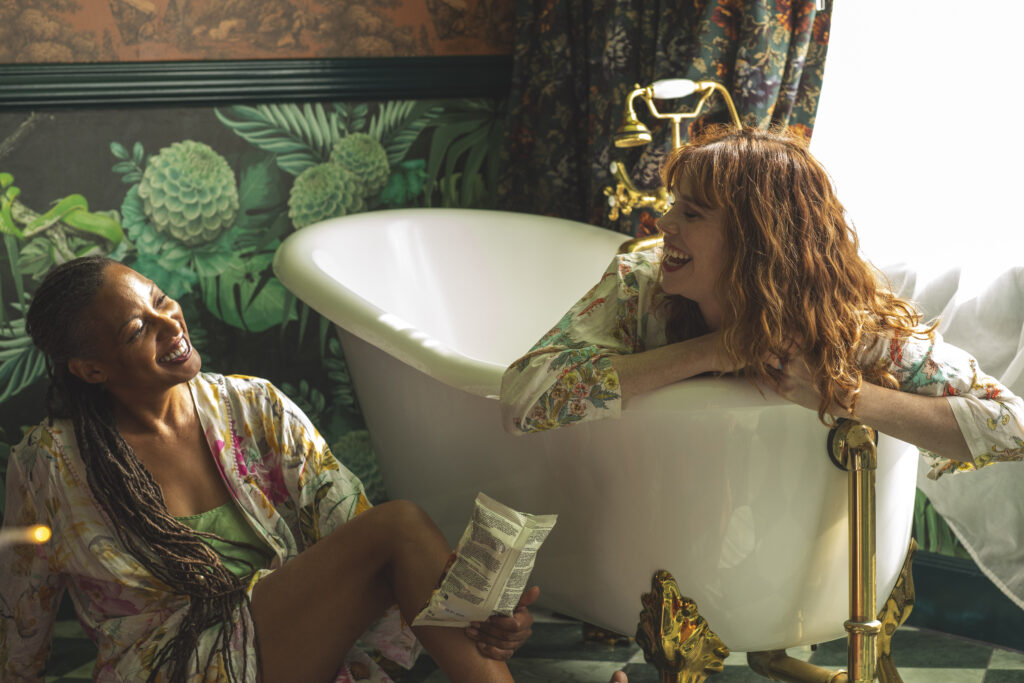
Ultimately, Straddle insists that queer women—especially as they age—deserve to be seen as whole: sensual, complicated, and vividly alive. It’s a play about love not as a feeling, but as a practice. About staying present when it would be easier to coast. About choosing each other again, even when it’s uncomfortable. It doesn’t offer answers so much as attention—and in a culture that so often looks away, that attention feels quietly radical. “Come and see for yourself,” Rivers says. The invitation is simple. The experience is anything but.